

Engagement model
Find out what should be built before you fund building it
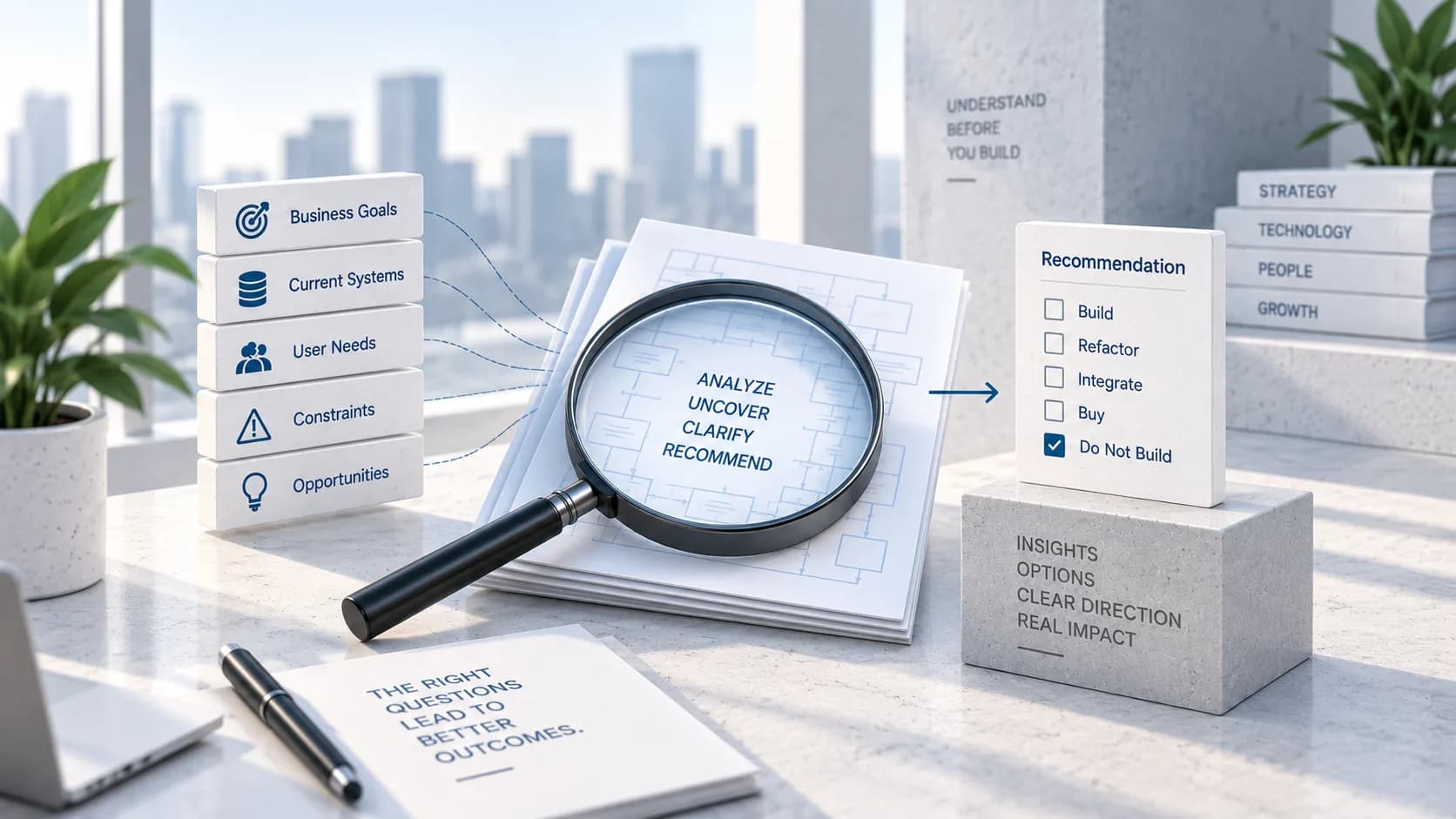
A short, bounded investigation into a decision you cannot take twice. It ends in a written recommendation, with the options considered and the reasoning for each — and that recommendation is allowed to be “do not build this”.
- Best for
- The problem is agreed and the solution is not.
- Engagement type
- Time-boxed investigation with a fixed fee.
- Your involvement
- Access to the people and systems that hold the answers, and a decision at the end.
- Our responsibility
- The evidence, the options and a recommendation we will defend.
- Primary outcome
- A decision you can fund, or a decision not to.
You probably need this when
Discovery is bought at a specific moment: when the cost of being wrong has become larger than the cost of finding out.
Something needs to change, but nobody agrees what to build
There are three plausible directions and three people confident in different ones. The disagreement is not about effort, it is about which problem is the real one.
A rebuild has been proposed and it is expensive
Someone has recommended replacing a system. The number is large, the reasoning is thin, and no one has tested whether repairing it would do.
A business case exists that nobody can evidence
The plan assumes a saving, an adoption rate or an integration that has never been checked against the actual system or the actual users.
A system is blamed for problems it may not be causing
Everything slow, expensive or unreliable gets attributed to one platform. Whether that is true has never been established.
You need an independent read before committing budget
You have a vendor proposal, an internal estimate, or both, and you want someone with no stake in the delivery to test them.
What this engagement means
You are buying an investigation and a documented recommendation. You are not buying an implementation, and nothing here obliges you to buy one afterwards.
This isn’t
- A proposal dressed as an investigation — the recommendation may be to build nothing
- A commitment to a delivery engagement with CipherCru
- A full architecture or a delivery-ready specification
- An estimate for work whose shape has not been agreed yet
- A document that only makes sense if we deliver the next phase
This is
- A bounded investigation into a specific question, agreed before it starts
- Direct access to your systems, data and people, so the findings are evidenced rather than assumed
- A written recommendation naming the options considered and the reasoning for each
- The risks and assumptions behind that recommendation, written down where you can argue with them
- A next-step direction you can hand to us, to an internal team, or to another supplier
What you get
Discovery is bought for its written output, so that is what it is judged on. Every item below is a document or a decision you keep.
- A problem statement in your own domain language
- A recommended direction, with the reasoning that produced it
- The options considered and why each was kept or set aside
- What we would do first, and what can wait
- What we examined — systems, code, data, integrations, process
- What we found, separated from what we were told
- Where the current system is genuinely at fault, and where it is not
- The assumptions the recommendation depends on
- What would have to be true for a different option to win
- The risks worth carrying, and the ones worth removing first
How we work together
Discovery is the model where the client keeps every decision and CipherCru owns the evidence. Nothing is delegated except the investigation itself.
| Responsibility | Client | Shared | CipherCru |
|---|---|---|---|
| The question being asked | Not included | Included | Not included |
| Access to systems and people | Included | Not included | Not included |
| Investigation and analysis | Not included | Not included | Included |
| Options and trade-offs | Not included | Not included | Included |
| The recommendation | Not included | Not included | Included |
| The decision that follows it | Included | Not included | Not included |
| Budget and timing | Included | Not included | Not included |
| Delivery of the next phase | Included | Not included | Not included |
How the engagement runs
Five stages, ending at a handover rather than a kickoff. The engagement is finished when you can act, whoever you act with.
Context
We agree the question, the boundaries and what a useful answer looks like. Getting this wrong is the only failure mode that cannot be recovered later.
Investigation
We read the system, the data and the history, and talk to the people who use and maintain it. What we are told and what we find are recorded separately.
Evaluation
Options are put against the constraints that actually apply — budget, team, timeline, risk appetite — rather than against an ideal.
Recommendation
We write the direction we would take and why, including the case against it. If the answer is to build nothing, that is what the document says.
Handover
We walk your team through the reasoning so the document survives without us, and answer the questions it raises.
Is this right for you?
Discovery earns its fee when a decision is genuinely open. When it is not, it is an expensive way to confirm something you already know.
A strong fit when
The decision is real, and the evidence to make it does not exist yet.
- You are about to commit meaningful budget on an unproven assumption
- Credible people inside the business disagree about what to do
- A proposal or estimate needs testing by someone with no stake in it
- You want a recommendation you can act on with or without us
Consider another model when
The question is already answered, or the need is capacity rather than clarity.
- You know what to build and need it estimated and delivered
- You need senior judgment on a decision you are already making, not a full investigation
- The work is understood and what you are short of is engineers
- You need someone to own delivery of an outcome end to end
Another model may suit you better: Consulting / Advisory — You need senior judgment applied to a decision already on the table, without a full investigation. Fixed-Scope Delivery — The outcome and its boundaries are already clear enough to scope, price and build.
This sounds like what we need.
Tell us what you are trying to decide. We will help work out whether a Discovery is the right way to answer it — and say so if it is not.
How it works commercially
Discovery is priced as a piece of work with an end, not as a retainer or a deposit against delivery.
Fees are agreed per engagement. Contractual detail lives in our engagement terms.
Compare relevant models
Discovery sits next to two models that are often considered at the same moment. The difference is how much is already decided.
| Discovery / Assessment | Consulting / Advisory | Fixed-Scope Delivery | |
|---|---|---|---|
| Best suited to | Uncertainty about what to build | A decision already framed | An outcome already understood |
| Main output | A written recommendation | Judgment on a specific decision | Working software |
| Is scope predetermined? | The question is; the answer is not | No — advice follows the decision | Yes, agreed before work starts |
| Who decides what happens next? | You do | You do | Agreed in the scope |
| Does CipherCru deliver afterwards? | Only if you choose to | Not automatically | Yes — that is the engagement |
Other ways to work with us
If the decision is further along than a Discovery assumes, one of these is probably the better starting point.
Consulting / Advisory
Senior engineering judgment applied to decisions you are already making — architecture, vendor choice, a rebuild someone has proposed. No delivery attached.
Best when you have the team but not the second opinion.
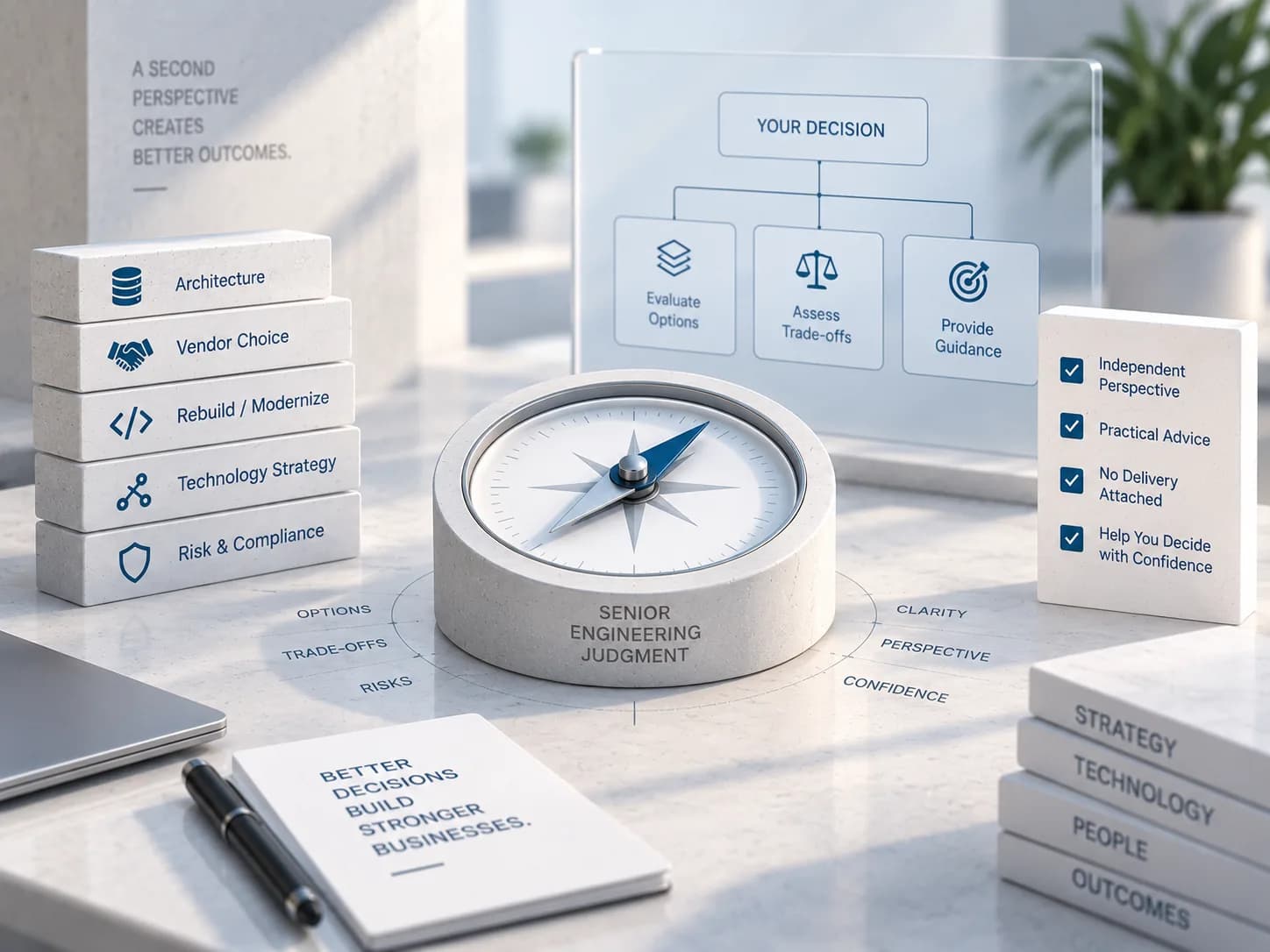
- Where it fits: an in-house team facing a decision it cannot take twice.
- Architecture review, technology selection, or a rebuild proposal tested before it is funded.
- You own the decision and the delivery; we own being right about what we told you.
Fixed-Scope Delivery
A defined piece of work, scoped and priced up front, delivered end to end. Scope changes are re-priced in the open rather than absorbed quietly.
Best when the scope is stable enough to write down and hold.
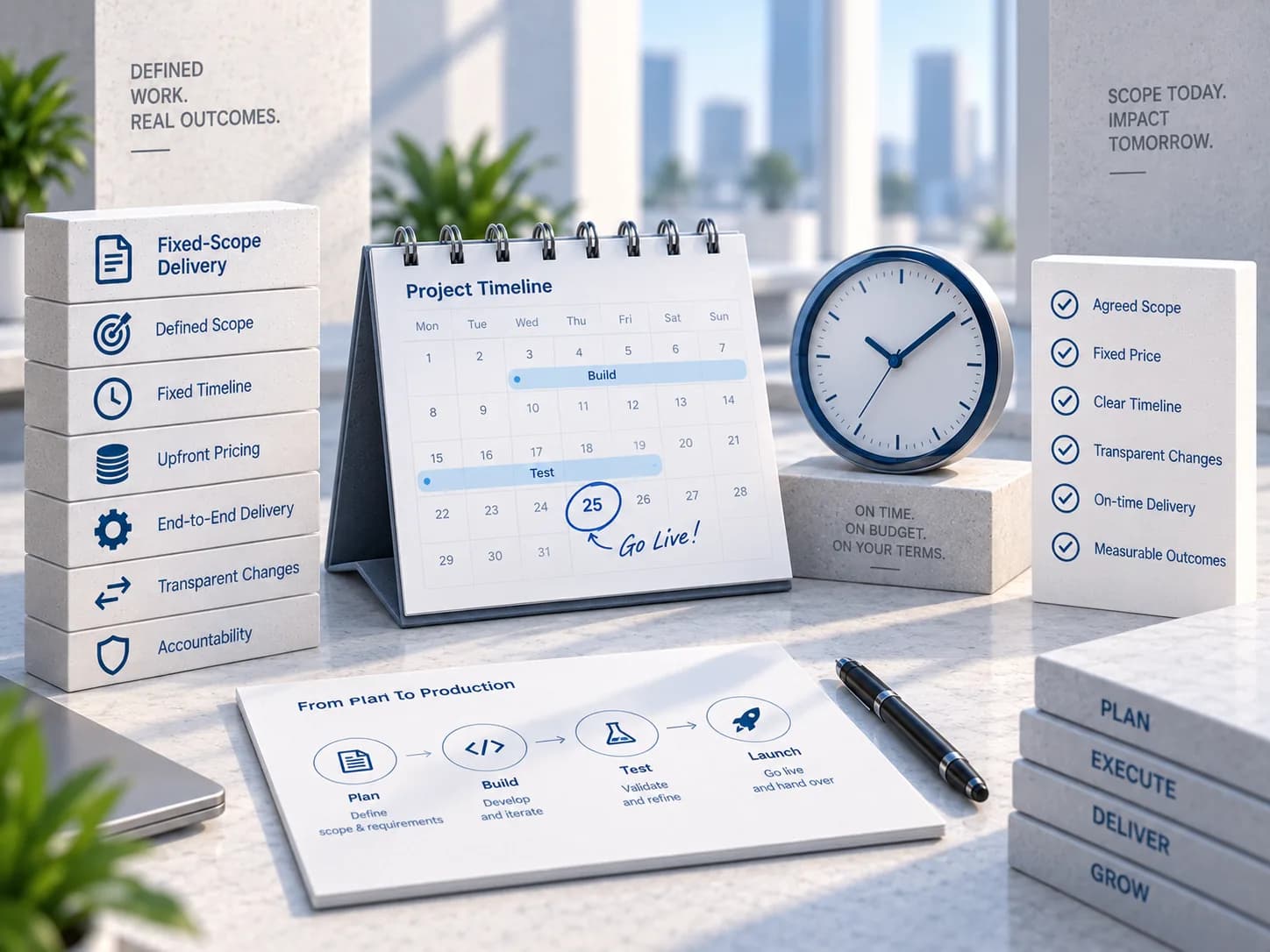
- Where it fits: a replacement, an integration, or a first release with firm edges.
- Fixed budget, so the risk of a wrong estimate is ours, not yours.
- We own scope, estimate and delivery risk; you own acceptance.
Not sure which model fits? Tell us the situation and we will point you at the right one. See all seven engagement models
Common questions
What clients ask before commissioning a Discovery.
Will you ever recommend that we don’t build anything?
Can we use the recommendation without engaging you further?
What do you need from our team?
How long does a Discovery take?
How is this different from your Consulting engagement?
Can you assess work proposed by our existing vendor?
Start with the question, not the build
Tell us what you are trying to decide and what it would cost to get it wrong. We will tell you whether a Discovery is worth commissioning.
Discovery / Assessment
Engagement model