

Engagement model
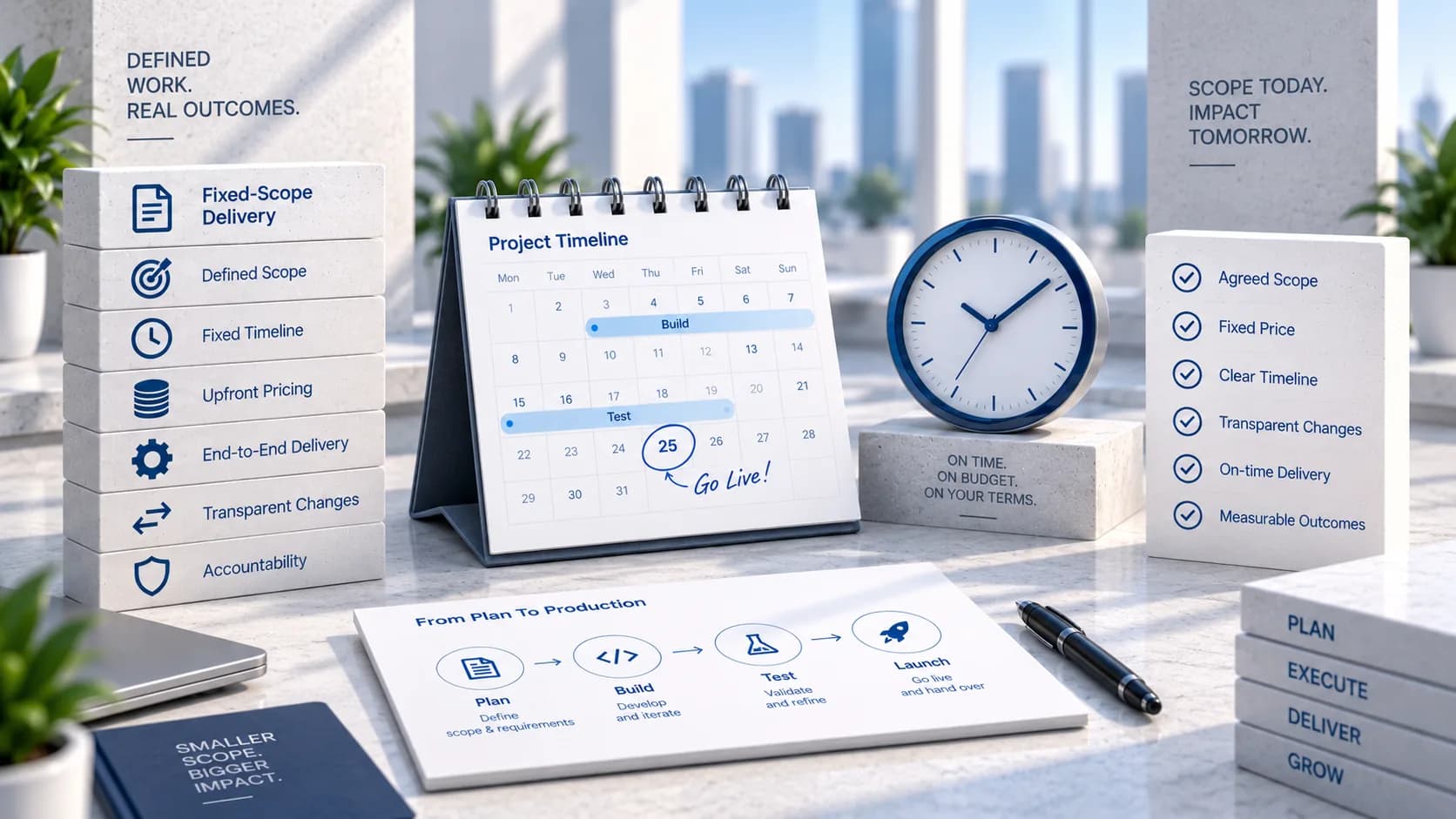
A defined piece of work, priced before it starts
When the outcome and its boundaries are properly understood, you should not have to buy it by the day. We scope it, price it, agree it and deliver it — and when scope genuinely changes, we re-price it in the open.
- Best for
- The outcome and its boundaries are already well understood.
- Engagement type
- A defined scope at an agreed price.
- Your involvement
- Scope agreement up front, decisions during, acceptance at the end.
- Our responsibility
- Delivering the agreed scope to the agreed standard.
- Primary outcome
- Working software, delivered and accepted.
You probably need this when
Fixed scope earns its place when uncertainty has already been removed — usually by someone having done the thinking first.
The work is well understood and genuinely bounded
You can describe what done looks like without hedging, and the edges of the work are clear enough to hold a price against.
The budget has to be approved before work starts
A number is needed for a board, a client or a funding round, and “we will bill you monthly” is not an answer that will pass.
There is a date that is not moving
A regulatory deadline, a contract, a launch. The scope can flex around it, but the date cannot.
A discrete piece needs building alongside other work
An integration, a migration, a module. Your team is busy elsewhere and this piece can be cleanly separated and handed over.
You want the delivery risk carried by the supplier
If the estimate is wrong, you would rather that be our problem than an overrun on your budget.
What this engagement means
You are buying an agreed outcome at an agreed price, and we carry the risk of delivering it. In exchange, the scope has to be held still enough to be priced.
This isn’t
- An open-ended arrangement that absorbs whatever the work turns out to be
- A way of pricing something nobody has properly defined yet
- Ongoing capacity — it ends when the work is delivered and accepted
- A licence to change direction without changing the price
- The right model when the outcome is still genuinely uncertain
This is
- A scope defined and agreed in writing before work starts
- A price agreed against that scope, with the delivery risk on us
- End-to-end delivery — built, tested and handed over
- Acceptance against criteria agreed at the outset, not invented at the end
- Material changes discussed and re-priced transparently rather than absorbed silently
What you get
The output is the thing itself, delivered and accepted — plus everything needed to own it afterwards.
- The functionality described in the scope, complete rather than nearly
- Tested to the standard agreed up front
- Deployed into your environment and working there
- A written scope with explicit inclusions and, importantly, exclusions
- An estimate and price agreed against it
- Acceptance criteria defined at the outset
- Technical documentation for what was built
- Handover to your team or whoever maintains it next
- A warranty period after acceptance for defects in the delivered scope
How we work together
Delivery sits firmly with CipherCru — that is what a fixed price buys. What stays with you is the scope decision and the acceptance.
| Responsibility | Client | Shared | CipherCru |
|---|---|---|---|
| Defining the scope | Not included | Included | Not included |
| Estimate and price | Not included | Not included | Included |
| Day-to-day priorities | Not included | Not included | Included |
| Technical decisions | Not included | Not included | Included |
| Engineering standards | Not included | Not included | Included |
| Delivery management | Not included | Not included | Included |
| Quality assurance | Not included | Not included | Included |
| Approving scope changes | Included | Not included | Not included |
| Acceptance | Included | Not included | Not included |
How the engagement runs
Six stages, and the first three happen before any code does. That front-loading is what makes the price hold.
Scope
We define what is being built and, just as carefully, what is not. Exclusions prevent more disputes than inclusions do.
Estimate
We size the work against that scope and say where the uncertainty sits. If it is too uncertain to price honestly, we say so here rather than pricing it anyway.
Agreement
Scope, price, acceptance criteria and timeline are agreed in writing before work begins.
Delivery
We build it, managing the work ourselves and reporting progress against the agreed scope rather than against hours spent.
Acceptance
You check the delivered work against the criteria agreed at the outset. No moving of the target in either direction.
Warranty
A period after acceptance during which defects in the delivered scope are our responsibility to fix.
Is this right for you?
This model is only honest when the outcome is genuinely understood. Fixing a price around uncertainty does not remove it — it just decides in advance who will pay for it.
A strong fit when
The work is defined, bounded, and unlikely to change shape while it is built.
- You can describe what done looks like without hedging
- The boundaries of the work are clear and stable
- A price has to be approved before anything starts
- You want the delivery risk carried by the supplier
Consider another model when
The outcome is still moving, or the need does not end.
- You are not yet certain what should be built
- The requirements are likely to change substantially during delivery
- You need ongoing capacity rather than one delivered piece
- You want us accountable for a business outcome, not a specification
Another model may suit you better: Discovery / Assessment — The outcome is not yet defined well enough to scope or price honestly. Managed Delivery — You want responsibility for the business outcome, not for delivering a specification.
This sounds like what we need.
Tell us what you need built and how firm it is. We will tell you whether it can be fixed-priced honestly — and what to do first if it cannot.
How it works commercially
The price is agreed against a defined scope. When the scope genuinely changes, so does the price, and you see the working.
Prices, payment points and warranty length are agreed per engagement. Contractual detail lives in our engagement terms.
Compare relevant models
These three differ in how much certainty exists before the money is committed.
| Fixed-Scope Delivery | Discovery / Assessment | Managed Delivery | |
|---|---|---|---|
| Best suited to | Clarity | Uncertainty | A defined outcome, undefined route |
| Is scope predetermined? | Yes, in writing | Only the question | The outcome is; the scope flexes |
| Is CipherCru accountable for delivery? | For the agreed scope | No | For the outcome |
| Is capacity ongoing? | No — it ends at acceptance | No | For the length of the outcome |
| What changes cost you? | A re-price | Nothing — it is an investigation | Re-prioritisation, not a re-price |
Other ways to work with us
If the scope will not hold still, one of these is the more honest arrangement.
Discovery / Assessment
A time-boxed investigation that ends in a written recommendation, including the recommendation not to build. You can act on it with us or without us.
Best when the problem is agreed and the solution is not.
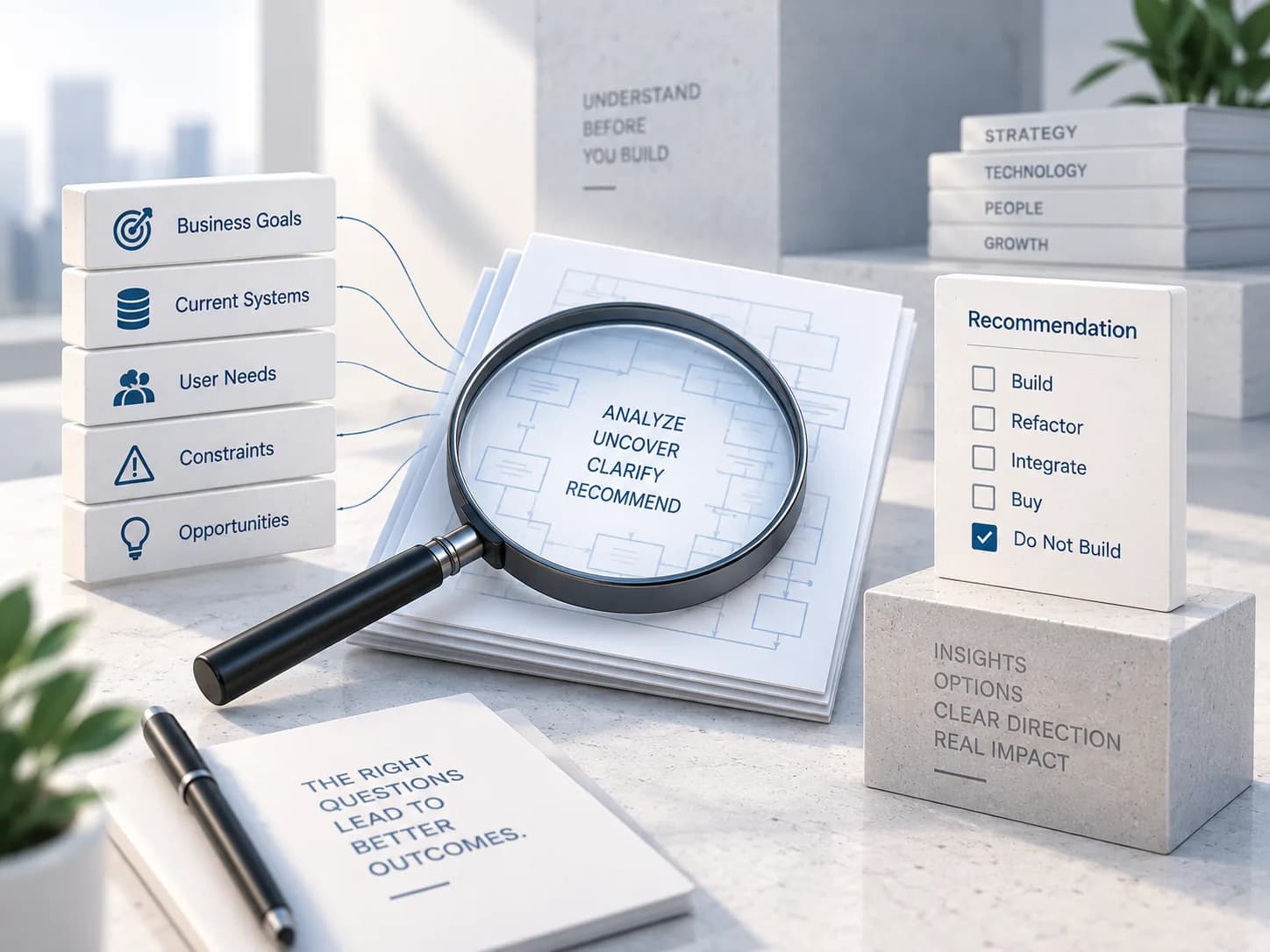
- Where it fits: a business case nobody can evidence, or a system everyone blames.
- A written problem statement, the options considered, and the reasoning for each.
- You own the decision at the end; we own the evidence behind it.
Managed Delivery
We take an outcome rather than a specification — assembling the team, running the delivery, and reporting against the business result you asked for.
Best when the result is agreed and delivery has no owner.

- Where it fits: an organisation with the outcome but no engineering function to run it.
- Reporting is against business milestones, not against hours booked.
- We own planning, staffing and delivery; you own the decisions and the result.
Not sure which model fits? Tell us the situation and we will point you at the right one. See all seven engagement models
Common questions
What clients ask before agreeing a fixed scope.
What happens when we want to change something mid-delivery?
What if you have underestimated the work?
We are not entirely sure what we need. Can you still fix the price?
What happens after you hand it over?
Who owns what you build?
How do we know it is on track?
Get a number you can actually take to a board
Tell us what needs building. If it can be fixed-priced honestly we will scope it — and if it cannot, we will tell you what to do first.
Fixed-Scope Delivery
Engagement model