

How you can work with us
Seven ways to work with us. One of them fits.
The right engagement is a question of how much control, responsibility and certainty you want to hold — not of how much software you are buying. These seven are ordered from clarity-first to delivery-led, so you can find your position on the spectrum.
- Not sure yet
- Start with Discovery or Advisory. Both end in a decision, not a commitment.
- You have the team
- Staff Augmentation adds capacity without moving delivery ownership.
- You need the team
- A Dedicated Team or a Retainer, depending on how continuous the work is.
- You want the result
- Fixed-Scope for a defined build, Managed Delivery for an outcome.
Engagement models are about ownership, not size
Most suppliers offer one way of working and describe every problem in its terms. We would rather tell you that the model you asked for is the wrong one — a fixed price around an undefined outcome, or a standing team for work that needs a retainer, costs more than the conversation that prevents it.
If you are not sure where you sit, the two entry models exist for exactly that. Both end in a written position you can act on with us or without us.
The seven models
Ordered as a continuum, from the models that resolve uncertainty to the models that take delivery responsibility.
Discovery / Assessment
A time-boxed investigation that ends in a written recommendation, including the recommendation not to build. You can act on it with us or without us.
Best when the problem is agreed and the solution is not.
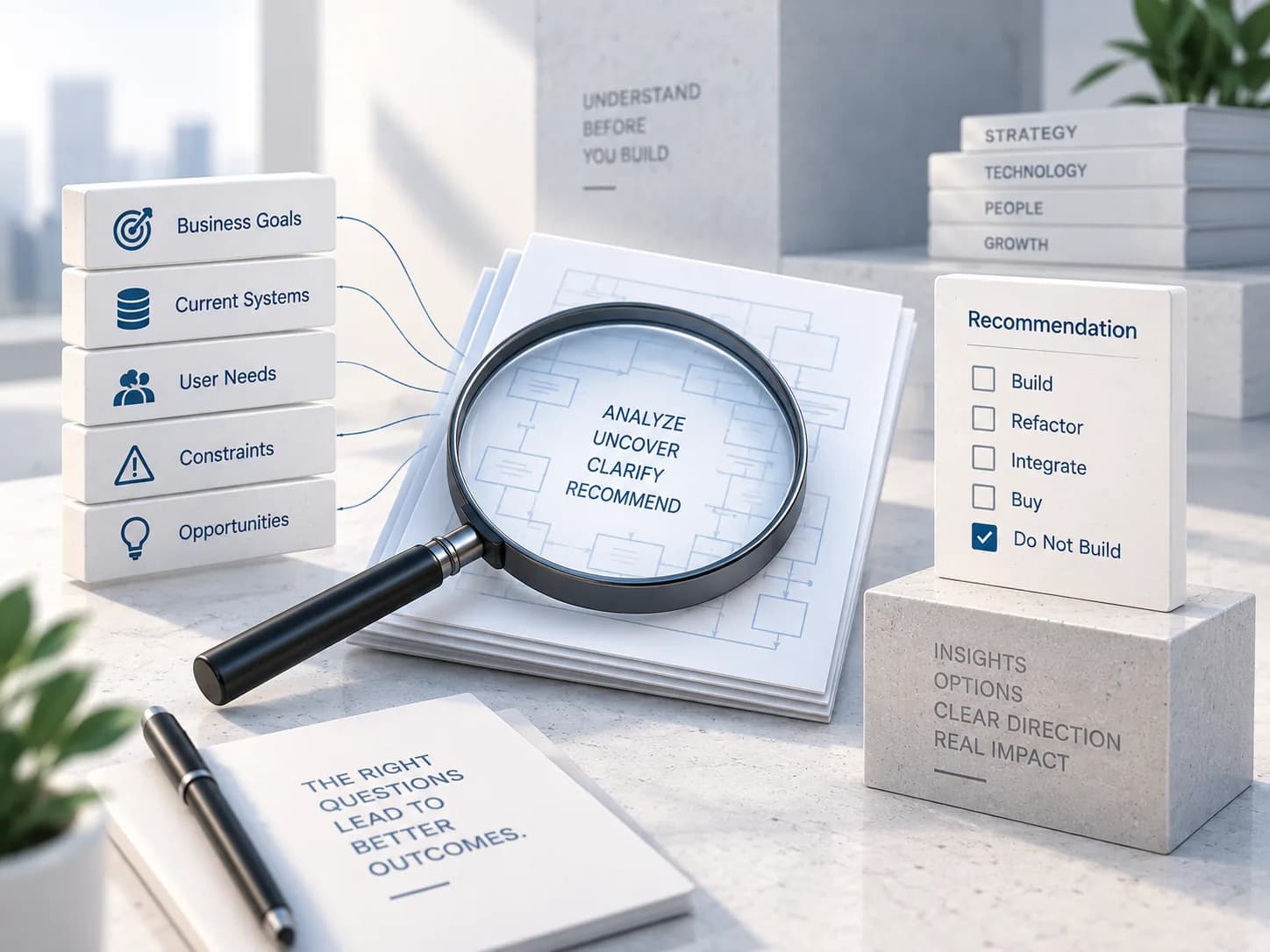
- Where it fits: a business case nobody can evidence, or a system everyone blames.
- A written problem statement, the options considered, and the reasoning for each.
- You own the decision at the end; we own the evidence behind it.
Consulting / Advisory
Senior engineering judgment applied to decisions you are already making — architecture, vendor choice, a rebuild someone has proposed. No delivery attached.
Best when you have the team but not the second opinion.
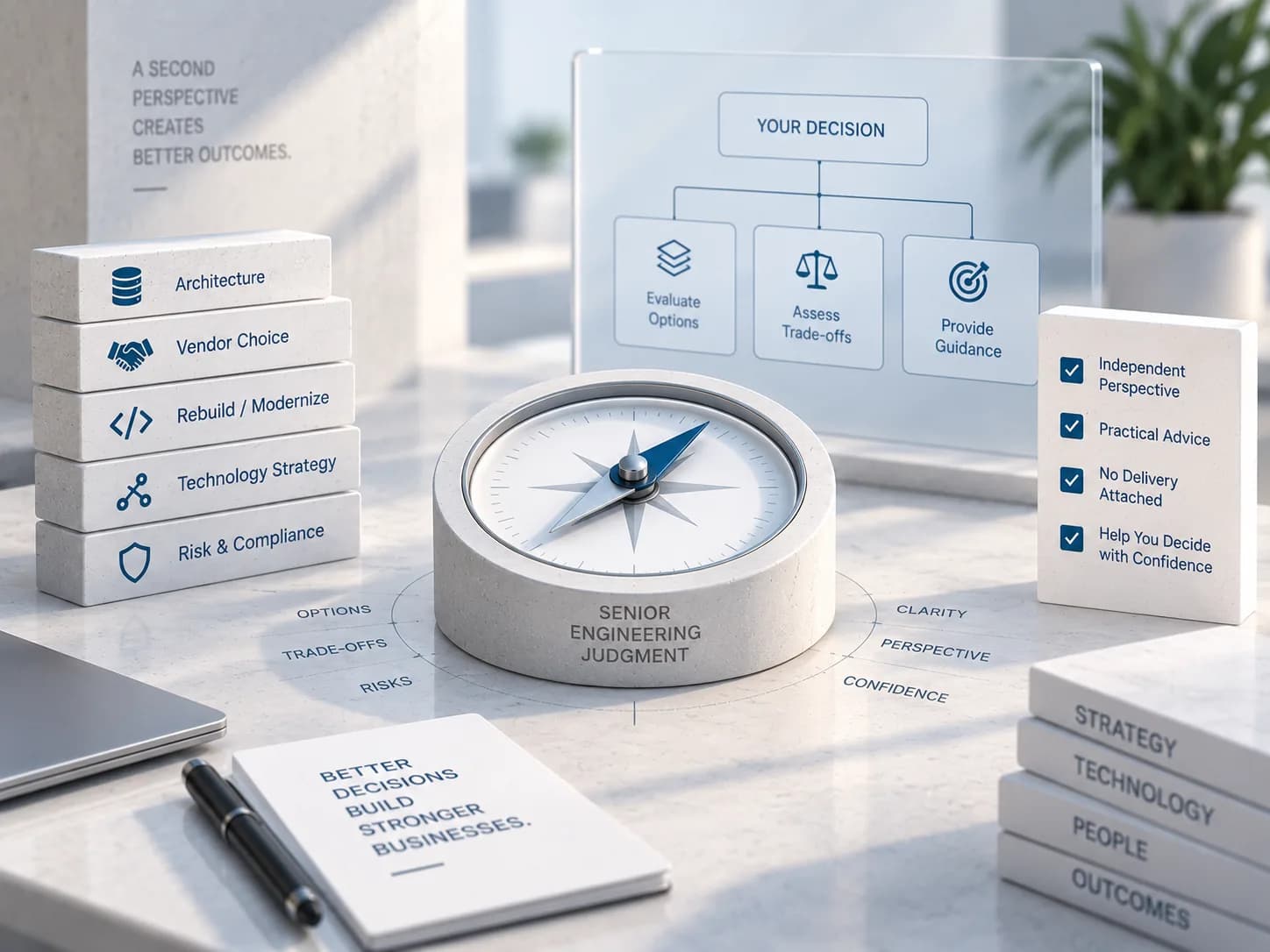
- Where it fits: an in-house team facing a decision it cannot take twice.
- Architecture review, technology selection, or a rebuild proposal tested before it is funded.
- You own the decision and the delivery; we own being right about what we told you.
Staff Augmentation
Senior engineers inside your team, under your process, your standards and your review. You direct the work day to day.
Best when you know what to build and lack the people.

- Where it fits: a roadmap that is agreed, funded and behind schedule.
- Knowledge transfer is a deliverable, so capacity does not become dependency.
- You own the backlog, the priorities and the delivery risk.
Dedicated Engineering Team
A standing team that works to your roadmap with our own delivery lead, engineering standards and quality bar. It ramps up and stays with the product.
Best when the roadmap is long and the requirements keep moving.

- Where it fits: a product roadmap that runs longer than any single project.
- A named delivery lead who is in the standups, not reporting on them.
- You own direction and priorities; we own how the team delivers them.
Retained Engineering
Reserved senior capacity for a system already in production — changes, integrations, incident support and the improvements a live business keeps needing.
Best when the software is live and the work never fully stops.

- Where it fits: a live system your team can run but not extend.
- Unused capacity is a signal to reduce the retainer, not to invent work.
- You own the operation; we own the engineering capacity you draw on.
Fixed-Scope Delivery
A defined piece of work, scoped and priced up front, delivered end to end. Scope changes are re-priced in the open rather than absorbed quietly.
Best when the scope is stable enough to write down and hold.
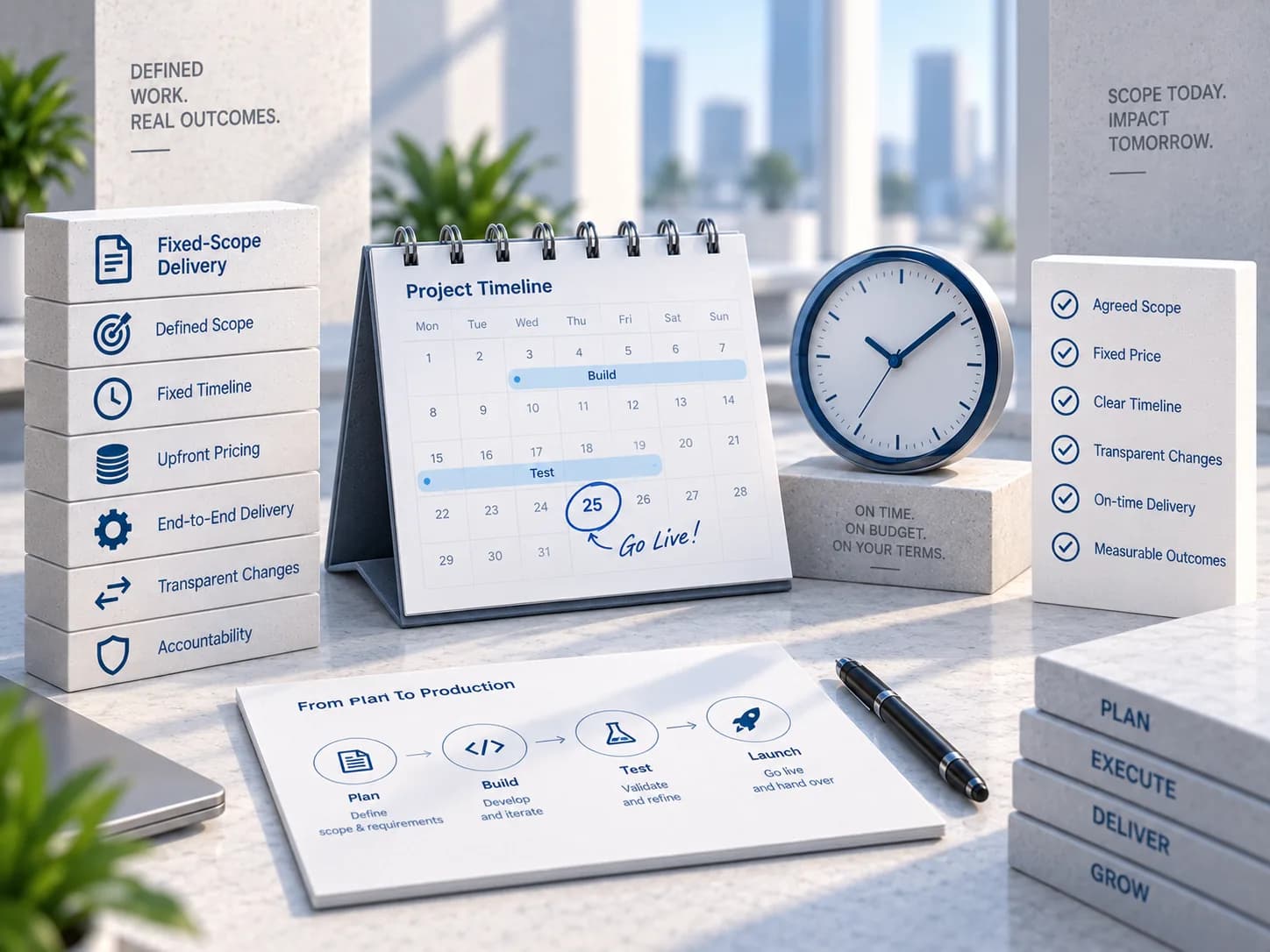
- Where it fits: a replacement, an integration, or a first release with firm edges.
- Fixed budget, so the risk of a wrong estimate is ours, not yours.
- We own scope, estimate and delivery risk; you own acceptance.
Managed Delivery
We take an outcome rather than a specification — assembling the team, running the delivery, and reporting against the business result you asked for.
Best when the result is agreed and delivery has no owner.

- Where it fits: an organisation with the outcome but no engineering function to run it.
- Reporting is against business milestones, not against hours booked.
- We own planning, staffing and delivery; you own the decisions and the result.
Each model has its own page covering what it is, what it is not, who is responsible for what, and how it works commercially.
Compare all seven
Four questions that narrow the field quickly. The detail pages carry the fuller comparisons against the two or three models each one is genuinely confused with.
| Discovery | Advisory | Staff Aug. | Dedicated Team | Retained | Fixed-Scope | Managed | |
|---|---|---|---|---|---|---|---|
| Who controls day-to-day work? | CipherCru | You | You | Shared | Shared | CipherCru | CipherCru |
| Is CipherCru accountable for delivery? | No | No | No | For the team | For the capacity | For the scope | For the outcome |
| Is scope predetermined? | The question is | No | No | No | No | Yes | The outcome is |
| Is capacity ongoing? | No | No | Yes | Yes | Reserved | No | For the outcome |
Choosing between them
The questions that come up before a model is chosen rather than after.
We don’t know which model we need. Where do we start?
Can we change model later?
Can we run more than one at once?
What is the smallest way to start?
What if we ask for the wrong model?
Start with the situation, not the model
Tell us what you are trying to solve, what you have already tried, and what is fixed. We will tell you which of these fits — including when the answer is none of them.